Property taxes, heating, insurance, water, septic systems, and maintenance: what buyers should budget for beyond the mortgage.
Updated November 20, 2026. All amounts are in Canadian dollars. Published rates are identified by their effective dates, and hypothetical calculations are labelled as estimates.
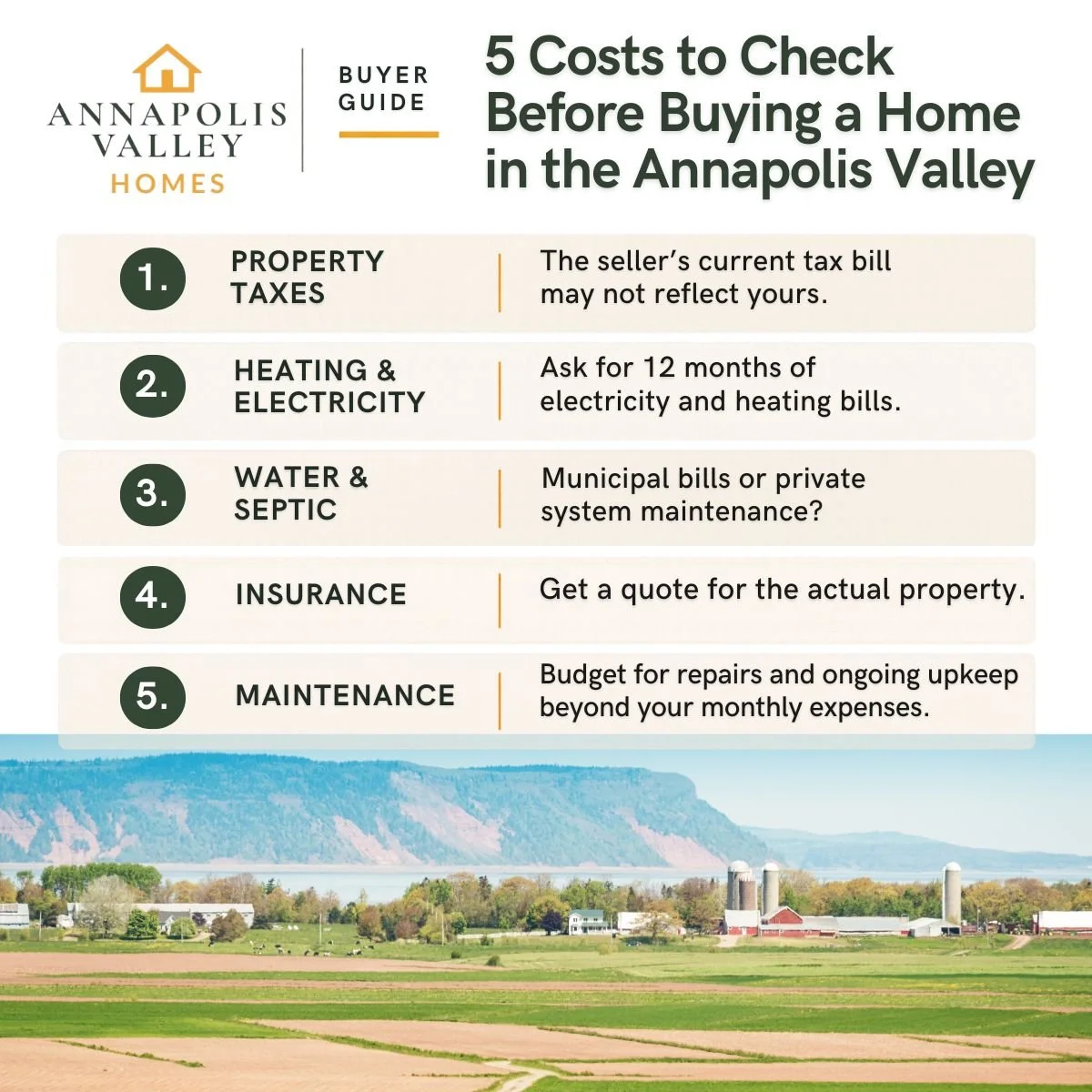
When you're searching for a home in Nova Scotia's Annapolis Valley, the purchase price is usually the first number you consider.
But what will that home actually cost to own?
Two houses with similar purchase prices can have very different ongoing expenses. A home in Kentville may come with municipal water and sewer bills and higher property taxes, while an older rural home could have lower base property taxes but greater heating costs, a private well and septic system, and more property maintenance.
If you're relocating from Ontario, British Columbia, or elsewhere in Canada, understanding these expenses before buying can help you choose a property that fits your budget.
Here's what to consider.
1. Property Taxes: Location Makes a Difference
Property tax rates vary across the Annapolis Valley. Even within Kings County, the amount you pay depends on the property's assessed value, municipality, and applicable local charges.
For the 2026–27 fiscal year, the Town of Kentville and the Municipality of the County of Kings have published the following residential base rates:
| Location | Base tax rate | Annual base tax* |
|---|---|---|
| Town of Kentville | $1.4662 per $100 | $5,864.80 |
| Rural Kings County | $0.853 per $100 | $3,412.00 |
*Based on a hypothetical $400,000 taxable assessment using 2026–27 base tax rates. Additional area rates and charges may apply.
Sources: Town of Kentville 2026–27 Approved Operating Budget and Kings County 2026–27 Tax Rates.
These are base tax calculations, not complete property tax bills.
Kentville's published 2026–27 rates also include a fire area rate of $0.045 and a hydrant rate of $0.0564 per $100 of assessment. Applying all three published components to the hypothetical $400,000 assessment produces approximately $6,270 annually, or $523 per month.
Rural Kings County properties can also have additional fire, village, recreation, and other area rates. These vary by location, so the $3,412 base calculation should not be treated as a complete rural property tax estimate.
Why the seller's current tax bill may be misleading
Nova Scotia has a Capped Assessment Program (CAP) that limits annual increases in taxable assessments for eligible properties.
When a property is sold to someone outside the eligible family relationships, the cap is generally removed for the following assessment year. The new owner's taxable assessment could therefore be higher than the seller's.
For buyers relocating from another province, it's also important to understand that CAP eligibility has residency requirements.
What to do before buying: Check the property's assessed and taxable values through the Property Valuation Services Corporation (PVSC), then confirm the applicable rates and charges with the municipality.
Don't assume the seller's existing tax bill will be your future bill.
2. Heating and Electricity: One of the Biggest Variables
The Annapolis Valley has a wide variety of housing, from newer construction to older farmhouses and traditional homes.
Some older homes use electric baseboard heating. Others may have heat pumps, oil heating, wood stoves, or combinations of systems.
The heating system matters, but so do insulation, air sealing, windows, home size, and how occupants use the property.
What does electricity cost in Nova Scotia?
Nova Scotia Power's standard residential rates, effective May 1, 2026, are:
Monthly fixed charge: $20.08
Electricity consumption: 19.128 cents per kilowatt-hour (kWh)
Using those published rates, here's how different monthly consumption levels translate into electricity charges:
| Monthly electricity use | Estimated monthly charge |
|---|---|
| 600 kWh | $135 |
| 1,000 kWh | $211 |
| 1,500 kWh | $307 |
| 2,000 kWh | $403 |
Illustrative calculations using Nova Scotia Power's May 1, 2026 residential rates ($20.08 monthly fixed charge + $0.19128/kWh). Rounded to the nearest dollar. Excludes applicable taxes and adjustments. These are not typical household usage estimates.
Source: Nova Scotia Power — Standard Residential Service Rate. Figures are rounded and exclude applicable taxes and adjustments.
These consumption levels are hypothetical. They are not averages for Annapolis Valley households or estimates of what a particular home will use.
An older electrically heated house may have substantially higher winter consumption than summer consumption.
How can you estimate a home's actual heating costs?
Ask the seller for the previous 12 months of electricity bills, preferably including monthly kWh consumption.
If the home uses oil, propane, or wood, ask about those expenses as well.
A year's worth of records provides a more useful starting point than relying on the size of the house or the type of heating system alone.
Remember that your actual expenses may differ depending on how you use the home.
3. Water and Sewer: In-Town Versus Rural Living
One important difference between some town properties and rural homes is how water and wastewater are managed.
Municipal water and sewer in Kentville
Homes connected to municipal services generally have recurring water and sewer charges.
Kentville's approved sewer rates, effective April 1, 2026, through March 31, 2027, include:
An annual base charge of $244.50 for a 5/8-inch residential meter.
A consumption charge of $5.69 per 1,000 imperial gallons.
For example, if a household used a hypothetical 12,000 imperial gallons annually:
| Sewer expense | Annual amount |
|---|---|
| Base charge | $244.50 |
| Consumption charge | $68.28 |
| Illustrative total | $312.78 |
Based on hypothetical annual consumption of 12,000 imperial gallons and Kentville's published 2026–27 sewer rates. Excludes municipal water charges and other applicable adjustments.
That works out to approximately $26 per month, excluding water charges and any other applicable adjustments.
Source: Town of Kentville — Approved Sewer Rate Changes.
Municipal water is billed separately.
Kentville submitted a water rate increase application in 2026. Its January 2026 public notice proposed increasing the average quarterly residential bill from $62.67 to $70.81 for 2026–27. That was a proposal, not an approved rate. A final approved 2026 rate schedule could not be independently confirmed for this article as of November 20, 2026.
For an accurate current figure, buyers should contact the Kentville Water Commission or request recent water bills for the property.
Private wells and septic systems in rural areas
Many rural properties in the Annapolis Valley rely on private wells and septic systems instead of municipal services.
You may not receive a monthly water or sewer bill, but that doesn't mean the systems are free to operate.
Ownership responsibilities can include water testing, treatment equipment, well pumps, septic pumping, maintenance, and eventual repairs or replacement.
Some expenses are occasional rather than monthly, making them easy to overlook when preparing a budget.
Before purchasing a rural property, investigate the condition and maintenance history of its water and wastewater systems.
For more information, read Buying a Rural Home in the Annapolis Valley: What to Know About Wells and Septic Systems.
4. Home Insurance: Get a Quote for the Actual Property
Home insurance is another expense that can vary significantly between two similarly priced homes.
Insurers may consider factors such as:
The age and condition of the property.
Electrical wiring, plumbing, and heating equipment.
Roof condition.
Proximity to fire protection services.
Outbuildings and other structures.
An older rural home may have different insurance requirements than a newer property within town limits.
Rather than relying on a provincial average, request an insurance quote for the specific property you're considering.
Ideally, confirm that suitable coverage is available and affordable before you're committed to completing the purchase.
5. Maintenance: Plan for Expenses That Don't Arrive Every Month
Every home needs ongoing maintenance, but older properties and larger rural lots can bring additional responsibilities.
Over time, expenses may include roof repairs, exterior painting, window replacement, drainage improvements, plumbing repairs, or heating equipment replacement.
Rural properties may also require driveway maintenance, snow removal, groundskeeping, or work on outbuildings.
How much should you budget?
One commonly used budgeting guideline is to set aside approximately 1% of a home's value annually for maintenance.
Using a hypothetical $400,000 home:
| Maintenance allowance | Amount |
|---|---|
| 1% annually | $4,000 |
| Monthly equivalent | $333 |
Illustrative maintenance reserve based on 1% of a hypothetical $400,000 home value annually. This is a budgeting guideline, not a verified Annapolis Valley maintenance average.
This is a budgeting guideline, not a verified Annapolis Valley maintenance average.
It is also not a guarantee that $4,000 will be enough. An older home with deferred maintenance could require substantial spending in a single year.
A professional inspection, available maintenance records, and the age of major components can help you assess whether a larger reserve is appropriate.
6. Comparing Two $400,000 Homes in the Annapolis Valley
Let's compare two hypothetical properties:
Home A: A home in the Town of Kentville connected to municipal water and sewer.
Home B: An older rural Kings County home with electric baseboard heating, a private well, and a septic system.
For the tax comparison, assume each property has a $400,000 taxable assessment. This is separate from the purchase price; actual assessments may differ.
| Expense | Home A: Kentville | Home B: Rural Kings County |
|---|---|---|
| Property taxes | Approx. $523/month using specified 2026–27 rates | Approx. $284/month using 2026–27 base rate, before area charges |
| Electricity | Actual consumption needed | Actual consumption needed; investigate winter baseboard heating costs |
| Water & wastewater | Municipal water and sewer bills | Private well and septic upkeep |
| Insurance | Property-specific quote required | Property-specific quote required |
| Maintenance reserve | Illustrative $333/month | Illustrative $333/month; possibly more depending on condition |
| Additional considerations | Municipal service charges | Driveway, grounds, outbuildings, private systems |
Illustrative comparison assuming a $400,000 taxable assessment for each property. Property taxes use published 2026–27 rates; other costs depend on the individual property. The two tax figures include different sets of charges and are not directly comparable final tax bills.
These figures do not represent complete monthly ownership budgets. They deliberately exclude costs that cannot be responsibly estimated without details about the individual properties.
The rural home's base property tax is lower in this example, but heating, maintenance, insurance, and private infrastructure could offset some or all of that difference.
Neither home is automatically the more affordable choice.
The most useful comparison is the total expected cost of ownership, including recurring bills and irregular expenses.
7. Seven Questions to Ask Before Buying
When you've found a home you're seriously considering, try to get answers to these questions:
Property taxes: What could the taxes be after ownership changes, including the removal of any assessment cap?
Heating: Can you review the previous 12 months of electricity and other heating expenses?
Insurance: Can you obtain suitable coverage, and what will it cost?
Water and wastewater: Is the home connected to municipal services or private systems?
Major repairs: What is the condition of the roof, heating equipment, electrical system, plumbing, and other major components?
Property upkeep: Will you be responsible for a long driveway, extensive grounds, or outbuildings?
Future expenses: Are there known maintenance issues or major replacements you should budget for?
You may not be able to predict every expense, but these questions can help you make a better-informed purchase decision.
Buying a Home in the Annapolis Valley from Outside Nova Scotia?
If you're relocating from another province, understanding the operating costs of a property is an important part of deciding whether it's the right fit.
A house that looks affordable based on its purchase price may have expenses you haven't encountered before, particularly if you're moving from an urban property to an older or rural home.
Morgan Worobec helps buyers explore homes throughout the Annapolis Valley and navigate the local buying process.
Considering a move to the Annapolis Valley? Contact Morgan to discuss the properties you're interested in and the questions worth investigating before you buy.
You can also read our guide to Buying a Home in the Annapolis Valley from Outside Nova Scotia.
Sources and rate information
Research checked November 20, 2026.
Town of Kentville — 2026–27 Approved Operating Budget: Property tax rates for 2026–27.
Municipality of the County of Kings — Tax Rates: Property tax rates and applicable area charges for 2026–27.
Nova Scotia Power — Standard Residential Service Rate: Electricity rates effective May 1, 2026.
Town of Kentville — Sewer Rate Changes: Sewer rates effective April 1, 2026, through March 31, 2027.
Kentville Water Commission — 2026 Rate Application Notice: Proposed water rate changes; not confirmation of approval.
PVSC — Capped Assessment Program: Assessment cap eligibility and treatment following property sales.
Rates and policies may change. Calculated examples are for illustration only and should not replace property-specific tax estimates, utility records, inspections, or insurance quotes.
